
A patient walked into a clinic in Jaipur last year missing a front tooth after a scooter accident. He asked one question before anything else: “Can I walk out today with a tooth, or do I wait months?” That single question is basically the whole debate between immediate loading implants and traditional implants, boiled down to one sentence.
Dental implants aren’t new anymore. What’s changed is the timeline — and that timeline is where most of the confusion sits. Some patients get a crown attached the same day their implant goes in. Others wait three to six months before anything sits on top of the titanium post. Neither approach is “wrong.” They just solve different problems, for different mouths, under different conditions.
The Core Difference: Timing, Not Technology
Both methods use the same basic implant — a titanium (or zirconia) post placed into the jawbone to act as an artificial root. The material hasn’t changed. What separates them is when the crown or bridge gets attached.
With traditional implants, the surgeon places the post and then closes the gum over it. The bone needs time to grow around the implant surface — a process called osseointegration. That takes roughly 3 to 6 months. Only after the bone has locked around the implant does the dentist attach the visible tooth.
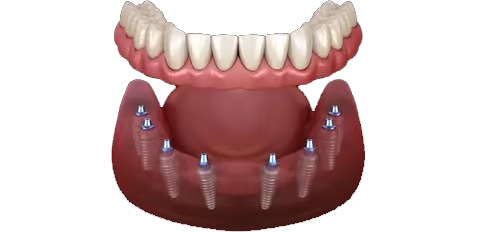
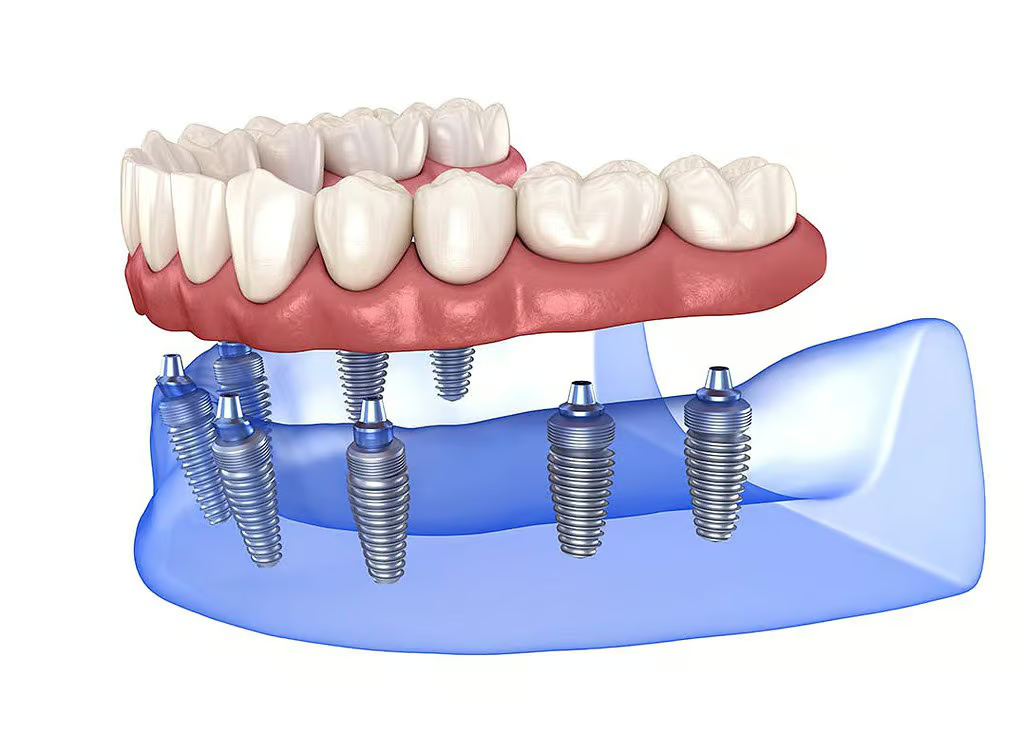
Immediate loading implants skip that waiting period. The crown, bridge, or denture gets fixed onto the implant within 24 to 48 hours of surgery — sometimes the same day. The bone is still healing underneath, but the patient isn’t walking around with a gap.
Why Immediate Loading Works At All
This sounds risky on paper. Attaching a load-bearing tooth before the bone has fully fused around the implant? It shouldn’t work, and for decades, it didn’t — not reliably.
What changed is implant surface technology and bone-density scanning. Modern implants have roughened, treated surfaces that grip bone faster than the smooth implants used in the 1980s and 90s. Combine that with 3D imaging (CBCT scans) that measure bone density before surgery, and dentists can now predict — with real accuracy — whether a jaw can handle immediate loading implants without the implant shifting or failing.
Not every jaw qualifies. That’s the part clinics don’t always explain clearly enough upfront.
Who Actually Qualifies for Immediate Loading
Bone quality is everything here. A dentist won’t just offer immediate loading implants because a patient wants them — the jawbone has to meet a density threshold, usually measured on a scale during the CBCT scan.
Good candidates typically have:
Dense, healthy jawbone in the implant site. No active gum infection. Enough bone height and width to anchor the implant firmly on day one. A bite pattern that won’t put excessive lateral pressure on the new implant while it heals.
Smokers, patients with uncontrolled diabetes, or anyone with thin, resorbed bone (common after years of missing teeth) usually gets steered toward the traditional route instead. It’s not a punishment — it’s just physics. A loose foundation can’t support weight immediately, no matter how good the crown looks.
Where Traditional Implants Still Win
I’ll say this plainly: traditional implants remain the safer default for most complicated cases, and dentists lean on them for good reason.
If a patient needs bone grafting first — because the jaw has thinned out from years of missing teeth — there’s simply no way around the wait. Grafted bone needs months to mature before it can even hold an implant, let alone bear a crown immediately. Multiple missing teeth, active infections, or a history of implant failure also push cases toward the traditional protocol.
There’s also a psychological angle nobody talks about enough. Some patients would rather have a slower, more conservative process with lower risk than a faster one with a slightly higher chance of complications. That’s a completely reasonable trade-off, and a good dentist will lay out both paths honestly instead of pushing the flashier option.
Cost, Comfort, and the Stuff Patients Actually Ask About
Immediate loading implants usually cost more upfront. The imaging, the surgical precision required, and the same-day prosthetic work all add to the bill. Traditional implants spread the cost and effort across multiple visits, which some patients actually prefer financially.
On comfort: immediate loading means one surgery, minimal gap-tooth embarrassment, and no removable temporary appliance. Traditional implants mean a longer healing window, sometimes with a temporary denture or flipper tooth in the meantime — which, let’s be honest, most patients dislike wearing.
Recovery pain is roughly similar between the two in the first week. Where they diverge is in the months after. Immediate loading implants carry a slightly higher risk of micro-movement during healing (which can affect long-term success if the bite isn’t managed carefully), while traditional implants have a well-documented, decades-long success rate — often cited above 95% for healthy candidates.
Success Rates and Long-Term Outlook
Studies on immediate loading implants generally report success rates between 90–97% in properly selected patients — patients who actually met the bone-density and health criteria mentioned earlier. That gap between 90% and 97% often comes down to case selection, not the technique itself.
Traditional implants have a longer track record simply because they’ve been the standard for longer. Their failure points are well understood: infection, poor bone integration, or excessive early load. Immediate loading implants fail for slightly different reasons — usually micromovement before the bone has locked in, which is why bite adjustment in the first few months matters so much.
Neither method is “better” in the abstract. The right one depends entirely on what a CBCT scan and a clinical exam reveal about a specific mouth.
Conclusion
If your jawbone is dense, healthy, and free of infection, immediate loading implants can genuinely get you from missing tooth to functioning tooth in under 48 hours — that’s not marketing, it’s a real outcome for the right candidate. If your case involves bone loss, grafting, or multiple extractions, don’t fight the timeline. Traditional implants exist because some situations need the extra months to heal properly, and rushing that process is how implants fail. Ask your dentist for a CBCT scan before either option gets discussed seriously — the scan, not your preference, should decide which path you take.

